

Elbow Pain: When It’s Not “Just Tennis Elbow” (And When to Get It Checked)
Introduction
Pain on the outside of the elbow is one of those things that people often try to push through.
It gets labelled as “tennis elbow”, maybe rested for a bit, stretched a little, and then ignored in the hope that it will settle on its own.
And often, that approach works.
But not always.
I recently spent a couple of days at BESS (a specialist shoulder and elbow conference here in Exeter), listening to surgeons, physiotherapists and extended scope practitioners who work with complex upper limb conditions every day.
What stood out wasn’t just the complexity of some of the diagnoses — it was how easily certain elbow problems can be missed or mislabelled, especially early on.
So this blog isn’t about making things sound scary.
It’s about helping you understand:
when elbow pain is likely to be simple and self-limiting
when it might need a closer look
and why the context (especially in children) really matters
The Problem With “Tennis Elbow” As a Default Label
“Tennis elbow” (lateral elbow pain) is one of the most common diagnoses we see in clinic.
It typically presents as:
pain on the outside of the elbow
worse with gripping, lifting or repetitive use
sometimes radiating down the forearm
And in many adults, that’s exactly what it is — a tendon-related issue that responds well to:
load management
progressive strengthening
time and patience
The problem is that the label “tennis elbow” often gets applied too quickly.
Because a number of other conditions can present in a very similar way — but require a different approach, or at the very least, a more careful assessment.
When Elbow Pain Isn’t “Just a Niggle”
1. Elbow Pain in Children — A Different Set of Rules
This is one of the biggest takeaways from the conference:
Children do not get tennis elbow.
So if a child or teenager presents with pain on the outside of their elbow, we need to pause and think more carefully.
One condition that needs to be considered is osteochondritis dissecans (OCD) — a condition affecting the joint surface, most commonly in the capitellum (part of the elbow joint).
It tends to occur in:
active children and teenagers (often aged 10–15)
those involved in repetitive loading sports (throwing, gymnastics, climbing, etc.)
What makes this important is that:
symptoms can be vague and ongoing
it can be mistaken for a simple overuse issue
early diagnosis improves outcomes
So if your child has:
persistent elbow pain
reduced range of movement
or mechanical symptoms like clicking or locking
…it’s worth getting it properly assessed rather than assuming it’s just a strain.
2. After a Fall — Even If It “Doesn’t Seem That Bad”
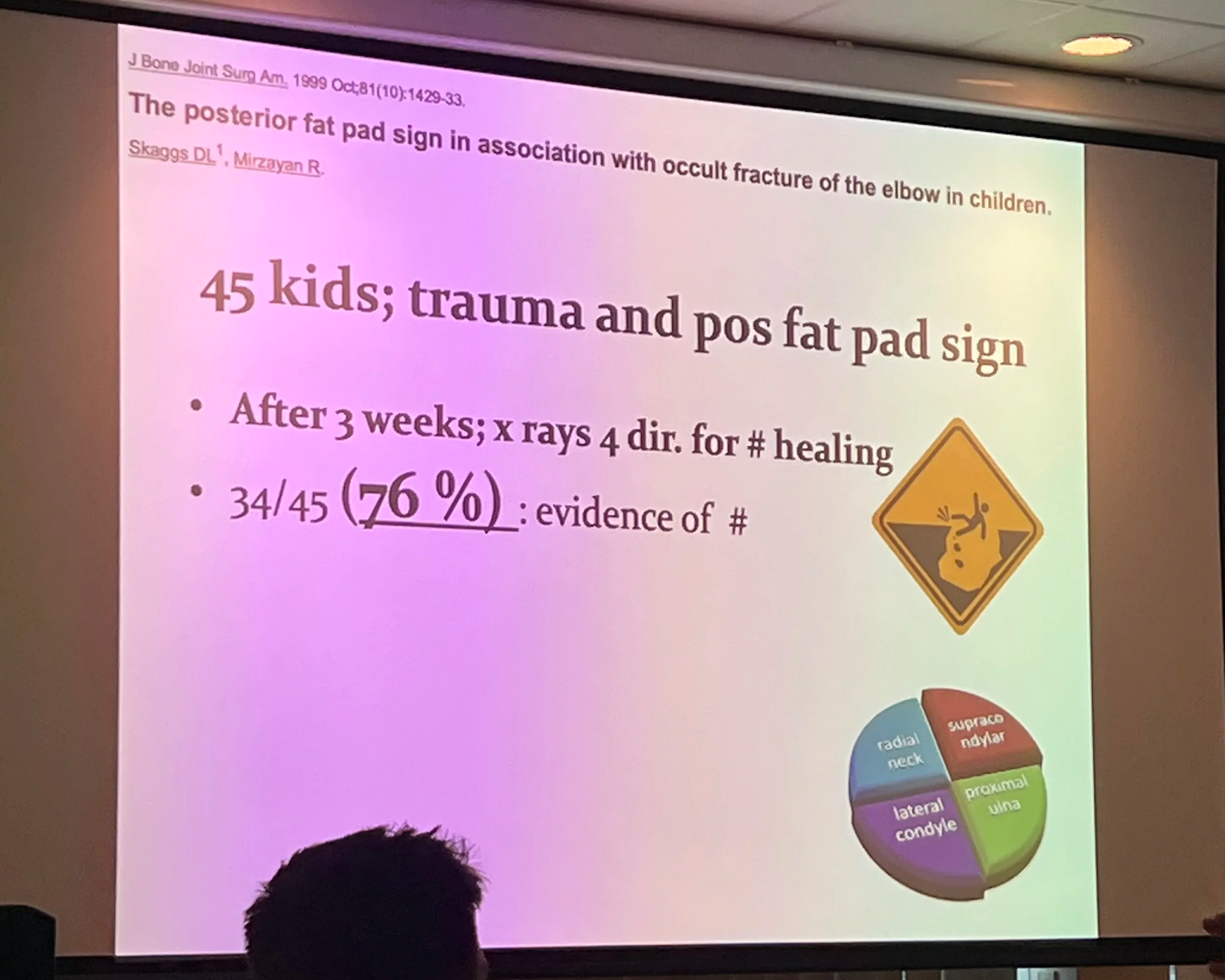
Missed fractures in children.
Check for elbow swelling (fat pad sign).
Another key learning point relates to trauma, especially in children.
At the conference, there was discussion around something called the fat pad sign on X-ray.
You don’t need to understand the technicalities — what matters is this:
In one study, 76% of children with this sign actually had a fracture, even when it wasn’t obvious initially.
That’s huge.
What this means in practice is:
children can have fractures that are not immediately visible
symptoms may appear relatively mild
but the injury still needs to be taken seriously
So if your child has had:
a fall onto their arm
swelling around the elbow
reluctance to use it
…it’s always better to err on the side of caution.
3. Clicking, Catching or Locking in the Elbow
If your elbow feels like it:
clicks
catches
or gets “stuck”
…it’s less likely to be a simple tendon issue.
At the conference, there was discussion around structures inside the joint, including:
plica (folds of synovial tissue)
joint surface irregularities
synovitis (inflammation within the joint)
A “true plica” (often anterolateral in the elbow) can cause:
snapping into extension
discomfort at certain points in movement
a feeling that something isn’t moving smoothly
These issues often require:
a more detailed assessment
sometimes imaging
and a slightly different rehab approach
4. When Weakness Doesn’t Match Pain
One of the more subtle (but important) conditions discussed was posterior interosseous nerve compression.
Again — you don’t need to remember the name.
But the takeaway is this:
If someone presents with:
unusual weakness in wrist or finger extension
pain that doesn’t behave like a typical tendon issue
or symptoms that feel “different”
…it may involve the nervous system rather than just muscle or tendon.
This is where a thorough assessment really matters.
5. Elbow Pain That Just Isn’t Improving
This is probably the most relevant point for most people.
If your elbow pain:
isn’t improving after a few weeks
keeps flaring up
or doesn’t quite behave as expected
…it’s worth asking:
“Is this definitely what we think it is?”
Most elbow problems are manageable.
But the key is:
👉 getting the diagnosis right early on
The Good News: Most Elbow Problems Are Treatable
One of the most reassuring messages from the conference was this:
Early movement and the right guidance are key.
There’s often a fear — especially after injury — that moving the elbow will make things worse.
But in many cases:
early mobilisation is beneficial
gentle movement helps recovery
and avoiding stiffness is important
There was also good evidence supporting:
manual therapy techniques
progressive rehabilitation
and simple strategies like taping to help manage symptoms
Understanding Recovery: “Be Patient, But Start Strong”
One phrase that stuck with me was:
“Be patient, but have a strong start.”
Elbow injuries can be frustrating because:
they’re involved in so many daily activities
they can feel slow to settle
and progress isn’t always linear
But outcomes are much better when:
the right diagnosis is made early
appropriate loading is introduced
and patients are guided through the process
When Should You Get Your Elbow Checked?
It’s worth getting your elbow assessed if:
pain isn’t improving after a few weeks
it started after a fall or injury
there’s clicking, catching or locking
there’s noticeable weakness
your child has elbow pain (don’t assume it’s the same as adults)
A Quick Note on Referral Pathways
Another really useful takeaway from the conference was clarity around referral pathways.
For example:
Finger injuries are often best seen by hand specialists (plastics)
Wrist and elbow issues may go via fracture clinic or specialist pathways
As clinicians, knowing where to refer — and when — makes a big difference to patient outcomes.
Final Thoughts
Elbow pain is common.
And in many cases, it’s simple, manageable, and settles with the right approach.
But not all elbow pain is the same.
This week was a good reminder that:
context matters (especially in children)
small details in symptoms matter
and getting the right diagnosis early can save a lot of time and frustration
If you’re unsure about your elbow — or your child’s — it’s always worth getting it checked.
Call to Action
If elbow pain is holding you back — whether that’s sport, work or day-to-day life — we’re here to help.
At Quay Kinetics Physio, we assess, diagnose and guide you through recovery with a clear, evidence-based plan.
👉 You can book an appointment directly via our website, or get in touch if you’re not sure where to start.
FAQs About Elbow Pain
Is elbow pain always tennis elbow?
No — while tennis elbow is common, other conditions can cause similar symptoms, especially in children or after injury.
When should I worry about elbow pain in a child?
If pain persists, follows a fall, or affects movement, it’s important to get it assessed.
Can elbow pain go away on its own?
Some cases do, but persistent or worsening pain should be assessed to avoid long-term issues.
At Quay Kinetics Physio in Exeter, we regularly assess and treat elbow pain in both adults and children.